Technologies

Production stack, chosen for longevity

What technologies does Kennedy Chokkalingam use?

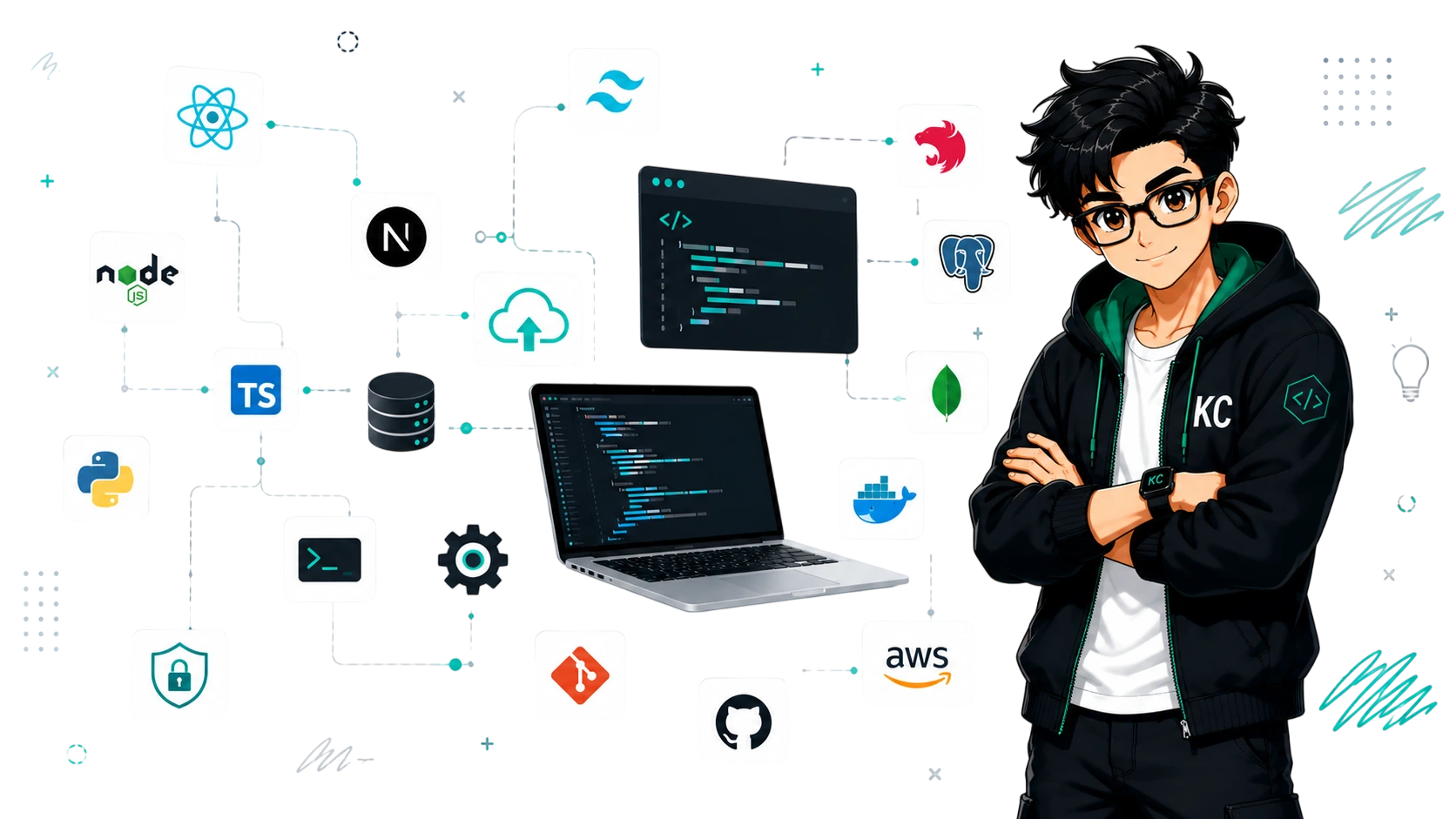
Kennedy Chokkalingam builds software with Next.js, React, TypeScript, NestJS, FastAPI, PostgreSQL, Redis, Docker, AWS, Flutter, and AI APIs — covering frontend, backend, mobile, databases, cloud, DevOps, integrations, architecture patterns, and security. The stack is selected per project for hiring continuity, deployment simplicity, and decade-long maintainability rather than trend-chasing.

Production-proven technologies chosen for maintainability, performance, and long-term scalability — not hype-driven stack decisions.

  • 11+ Years Production Use
  • SaaS & MVP Focus
  • Cloud-Native Deployment
  • AI-Ready Architecture
View portfolio
  • Maintainable defaults

    Stacks teams can hire for and operate for years

  • Per-engagement fit

    Stage, compliance, and ops constraints drive choices

  • Full delivery surface

    Frontend through cloud, mobile, AI, and security

Stack

Full technology library

Browse by layer — icons mark tools used in production engagements.

Technologies are chosen per engagement based on product stage, team skills, compliance needs, and long-term hiring — not a one-size-fits-all default.

44 capabilities across the library

Layer-tagged stack

Frontend

5 items

  • Next.js
  • React.js
  • TypeScript
  • Tailwind CSS
  • ShadCN UI

Backend

3 items

  • FastAPI
  • NestJS
  • Express.js

Mobile

4 items

  • React Native
  • Flutter
  • Android Native
  • iOS Native

Database

4 items

  • PostgreSQL
  • MongoDB
  • MySQL
  • Redis

Cloud & Hosting

5 items

  • AWS
  • Azure
  • DigitalOcean
  • Vercel
  • Cloudflare

DevOps & CI/CD

6 items

  • Docker
  • Kubernetes
  • GitHub Actions
  • GitLab CI/CD
  • Terraform
  • Monitoring & Logging

Integrations

5 items

  • Payment Gateways
  • CRM & ERP Systems
  • WhatsApp / Meta APIs
  • OAuth & SSO
  • Webhooks & Event Pipelines

Architecture & Patterns

6 items

  • Multi-Tenant SaaS
  • REST & GraphQL APIs
  • Event-Driven Systems
  • Microservices & Modular Monoliths
  • CQRS & Background Jobs
  • Domain-Driven Design

Security & Compliance

6 items

  • OAuth 2.0 & SSO
  • Role-Based Access Control
  • Encryption at Rest & Transit
  • Audit Logging
  • Rate Limiting & WAF
  • HIPAA-Aware Patterns

In practice

How the stack is applied

Same tools, different compositions — SaaS tenancy, ops depth, and AI workflows.

01

SaaS & Multi-Tenant Architecture

How is the stack applied to SaaS products?

SaaS platforms use Next.js or React frontends with NestJS or FastAPI backends, PostgreSQL for relational data, Redis for queues and caching, and Stripe or Razorpay for billing. Tenant isolation, subscription entitlements, and admin tooling are designed into the domain model from the first sprint.

Background jobs handle emails, webhooks, imports, and reports without blocking user requests. Docker and CI/CD pipelines deploy to AWS, DigitalOcean, or Vercel depending on traffic and compliance requirements.

  • Next.js
  • NestJS
  • PostgreSQL
  • Redis
  • Stripe
  • Multi-Tenant
02

Deployment & DevOps Depth

How are applications deployed and maintained?

Production deployments use Docker containers, nginx reverse proxies, GitHub Actions or GitLab CI, and environment-specific configuration. Monitoring covers error rates, queue depth, and database performance — with runbooks for rollback and incident response.

Infrastructure choices balance cost and reliability: Vercel for marketing and dashboard frontends, dedicated servers or AWS for API-heavy workloads, and Cloudflare for CDN and DDoS protection at the edge.

  • Docker
  • GitHub Actions
  • AWS
  • Vercel
  • Cloudflare
  • Monitoring
03

AI & Intelligent Workflows

How is AI integrated into business software?

LLM integration uses OpenAI or compatible APIs with RAG pipelines over approved documents, prompt templates, and guardrails for PII and hallucination risk. AI features ship as product capabilities — in-app assistants, classification, summarization — not disconnected demos.

Vector search, embedding pipelines, and cost controls keep token usage predictable as user volume grows.

  • OpenAI
  • RAG
  • Embeddings
  • Guardrails
  • Vector Search
  • Cost Controls